
The 6 Best QuickBooks Alternatives in 2026
QuickBooks Online raises prices most years and Desktop is gone for new buyers. Six alternatives for small-business books — ranked, priced, and honest about which ones your accountant will accept.
- Every price checked August 2026
- Free and paid options included
- No affiliate-driven rankings
The 6 best QuickBooks alternatives, ranked
Ranked by how completely each one runs a small business's books — and by whether you can still read them in ten years.
- 01
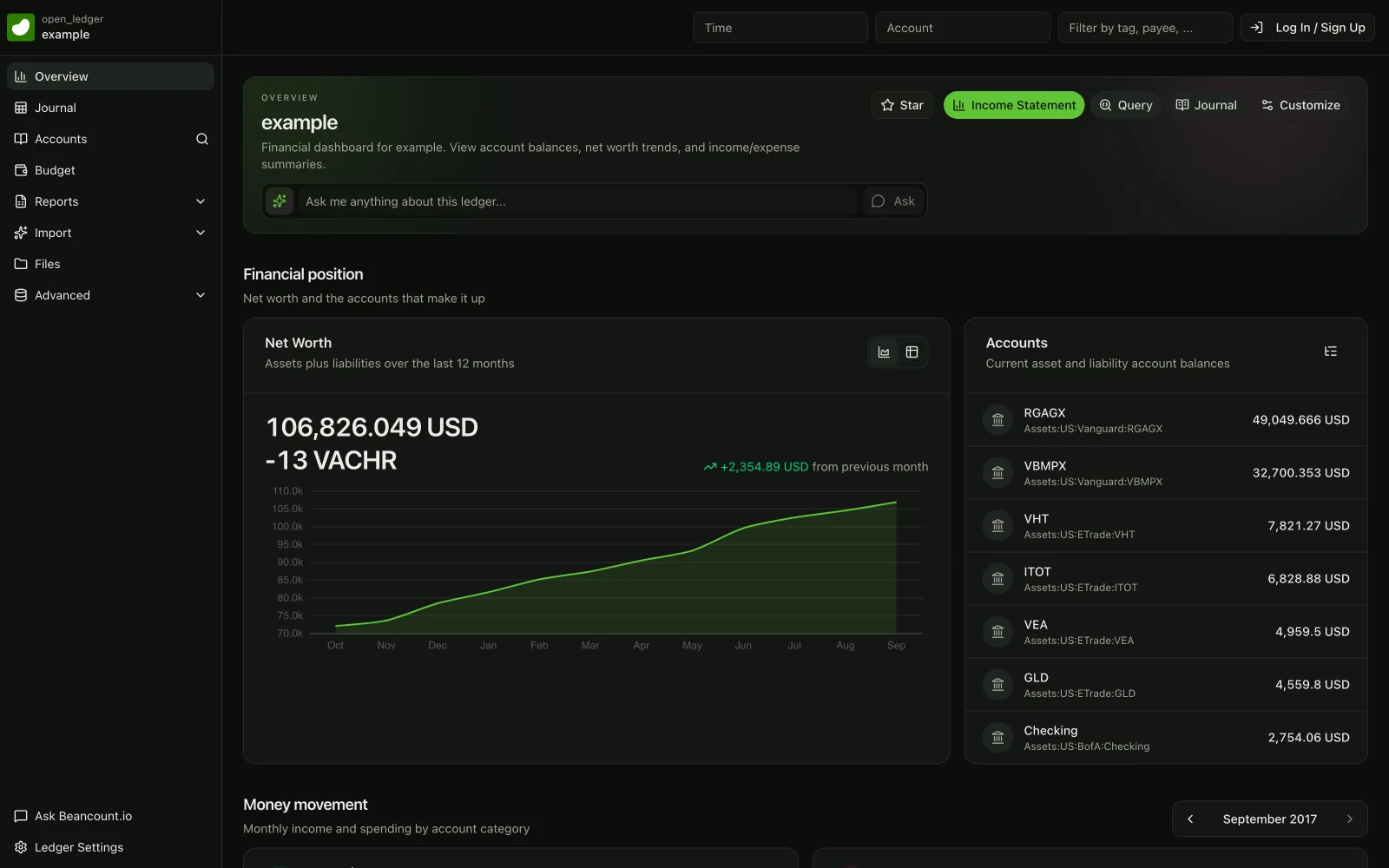
Beancount.io
Free core · optional hosting
Plain-text double-entry accounting: your books are text files you own, checked by real accounting rules, with hosted bank sync and reporting on top.
Best for: Technical founders and finance-literate owners who want books that are auditable, scriptable and permanent rather than rented.
Strengths
- Books as plain text you own — no export step, no subscription holding them
- Double-entry rules catch what a categorization UI silently absorbs
- Multi-currency, inventory and cost basis handled properly, not approximated
Trade-offs
- No built-in payroll, and your accountant may not know the format
- You set up your own chart of accounts instead of accepting a template
- 02
Xero
About $20–$80/mo
The closest like-for-like replacement: full double-entry accounting, unlimited users, and an accountant ecosystem nearly as deep as Intuit's.
Best for: Businesses that want to leave QuickBooks without retraining anyone, and whose accountant already supports Xero.
Strengths
- Unlimited users on every plan — QuickBooks charges per seat
- Genuinely good bank reconciliation and a large app marketplace
- Most accountants can work in it without a fuss
Trade-offs
- US payroll is outsourced to a partner rather than built in
- Still a subscription around a database you do not hold
- 03
Wave
Free tier · paid plan about $16/mo
Free accounting and invoicing for very small businesses, paid for by payment processing.
Best for: Sole traders and microbusinesses whose books are simple and whose budget is zero.
Strengths
- A real free tier, not a trial — invoicing and accounting included
- Simple enough to run without an accountant for straightforward books
- Payments and payroll available when you need them
Trade-offs
- Thin on inventory, projects and multi-currency
- Bank connections are behind the paid tier and coverage varies
- 04
FreshBooks
About $19–$60/mo
Invoicing-first accounting built around billable time rather than inventory.
Best for: Freelancers and service businesses whose main job is getting invoices out and paid.
Strengths
- The nicest invoicing and time-tracking on this list
- Client-facing polish that wins repeat work
- Simple enough that you will actually keep it current
Trade-offs
- Weaker as a general ledger than Xero or QuickBooks
- Billed per client on lower tiers, which bites as you grow
- 05
Zoho Books
Free tier · paid from about $15/mo
Capable double-entry accounting at a low price, strongest if you already live in the Zoho suite.
Best for: Cost-sensitive businesses that want real accounting features without QuickBooks pricing.
Strengths
- Feature-for-price the best value here, including a free tier
- Proper inventory, projects and multi-currency support
- Fits neatly if you already use Zoho CRM or Inventory
Trade-offs
- Fewer accountants know it, so handover can be work
- Best value assumes you adopt more of the suite
- 06
GnuCash
Free, open source
Free, open-source desktop double-entry accounting that has outlived several commercial rivals.
Best for: Owners who want real double-entry books on their own machine and do not need a team or a web app.
Strengths
- Free forever, with your data in a local file
- Genuine double-entry accounting, not simplified bookkeeping
- Stable and maintained for over two decades
Trade-offs
- Desktop-only, single-user in practice
- The interface shows its age, and bank feeds are fiddly
QuickBooks alternatives compared
The five things small-business owners ask about most. Prices checked August 2026.
| What matters | Beancount.io | Xero | Wave | FreshBooks | Zoho Books | GnuCash |
|---|---|---|---|---|---|---|
| Cost | Free open-source core; pay only for optional hosting | About $20–$80/mo, unlimited users | Free tier; about $16/mo for the paid plan | About $19–$60/mo, billed per client on lower tiers | Free tier; paid from about $15/mo | Free, open source |
| Who owns the data | You do — plain-text files on your own disk | Xero's cloud; CSV and report export | Wave's cloud; CSV export | FreshBooks' cloud; CSV export | Zoho's cloud; CSV export | You do — a local file you back up yourself |
| Real double-entry | Yes, enforced — a transaction must balance | Yes, full general ledger | Yes, though simplified in the UI | Yes, added later and lighter | Yes, full general ledger | Yes, and strictly |
| Accountant familiarity | Low — expect to export reports for them | High — the main QuickBooks rival | Moderate for very small books | Moderate, common among freelancers | Lower outside its own ecosystem | Low — most firms will ask for exports |
| Payroll | Not built in; record it from your provider | Via partners in most regions | Paid add-on in supported regions | Via a partner integration | Available in some regions | None |
Frequently Asked Questions
What is the best QuickBooks alternative for a small business?
For most businesses leaving QuickBooks, Xero is the closest like-for-like swap: full double-entry accounting, unlimited users on every plan, and an accountant ecosystem nearly as deep as Intuit's. If cost is the driver, Zoho Books gives you real accounting features from around $15 a month and Wave has a genuinely free tier for very small books. If what bothers you is that a subscription holds your ledger, Beancount.io is the structural answer: your books are plain-text files you own, checked by double-entry rules, and no lapse in billing can take them away.
Is there a free alternative to QuickBooks?
Two, in different shapes. Wave is free cloud accounting and invoicing for very small businesses, funded by payment processing — bank connections sit behind its paid plan. GnuCash is free open-source desktop double-entry accounting that has been maintained for over two decades, with your data in a local file. Beancount is free open-source software too; you only pay if you want hosted extras like bank sync, and the ledger itself is a text file that never sits behind a paywall.
Will my accountant work with a QuickBooks alternative?
Usually yes, but it varies by tool. Xero is the safest bet — most firms support it directly. FreshBooks is common among freelancers. Zoho Books, GnuCash and Beancount are less familiar, so expect to hand your accountant exported reports (profit and loss, balance sheet, general ledger) rather than direct access. That is a normal arrangement, but it is worth asking your accountant before you migrate rather than after.
What happened to QuickBooks Desktop?
Intuit has been steering everyone to QuickBooks Online for years and closed Desktop to new subscribers, so the buy-it-and-own-it option many small businesses relied on is effectively gone. That is what drives most searches for alternatives: not a missing feature, but the shift from software you ran to a subscription you rent. It is also why the two locally-owned options on this list — GnuCash and Beancount — matter more than their market share suggests.
Can I move my QuickBooks data to another system?
Partly. QuickBooks exports lists and transactions as CSV or Excel, and Xero, Zoho Books and Wave all have import paths for them. What rarely survives is the fiddly stuff: attachments, memorised transactions, custom reports and payroll history. The practical approach is to close out a fiscal year in QuickBooks, carry opening balances into the new system, and keep the old file read-only for reference. For Beancount, the CSV columns map onto balanced double-entry transactions, so the imported history is verified rather than merely copied.
Books you own, not books you rent
Start free with plain-text double-entry accounting — bank sync, reporting and imports are there when you want them.